> ## Documentation Index
> Fetch the complete documentation index at: https://docs.flowpayroll.ai/llms.txt
> Use this file to discover all available pages before exploring further.
# Salary
> Record an employee's annual salary as a dated history, choose how part periods are pro-rated, and understand the salary lines that appear on a pay run.
An employee's salary is a history, not a single number. You record what somebody earns and the date it takes effect, and earlier figures stay exactly where they are. The pay run then pays the salary that was in force on each day of the pay period, so a joiner, a leaver or a rise part-way through a month is worked out for you.
Salary is being turned on organisation by organisation. Until it reaches yours, salary stays a single figure on an employee's payroll and tax details, and nothing on this page appears.
## Where the history lives
Open **People**, choose a person, and go to the **Employment** tab. The **Salary** card shows the salary in force today. **View salary history** opens every version behind it: the date it took effect, the annual amount, the reason if one was recorded, and who recorded it and when.
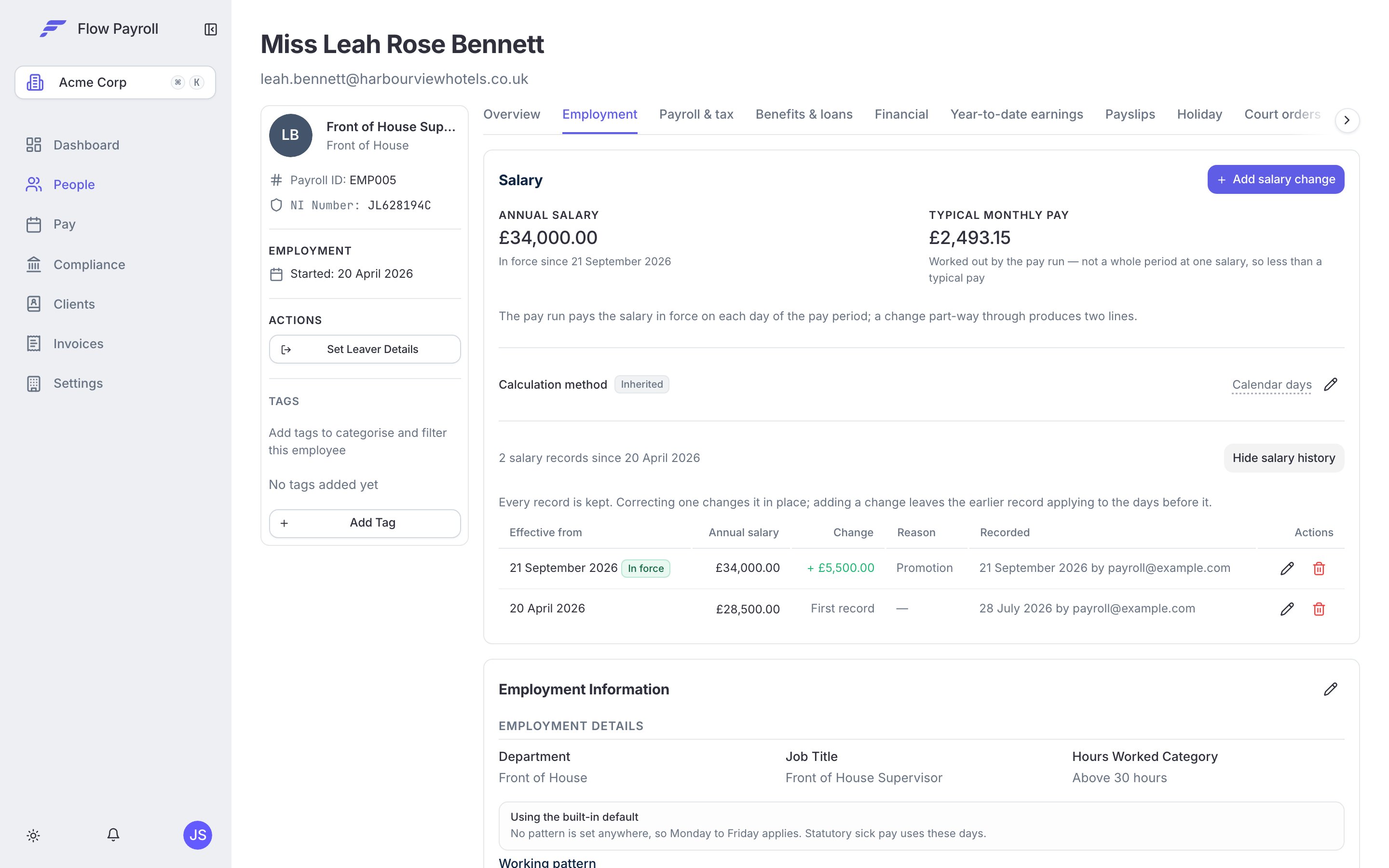
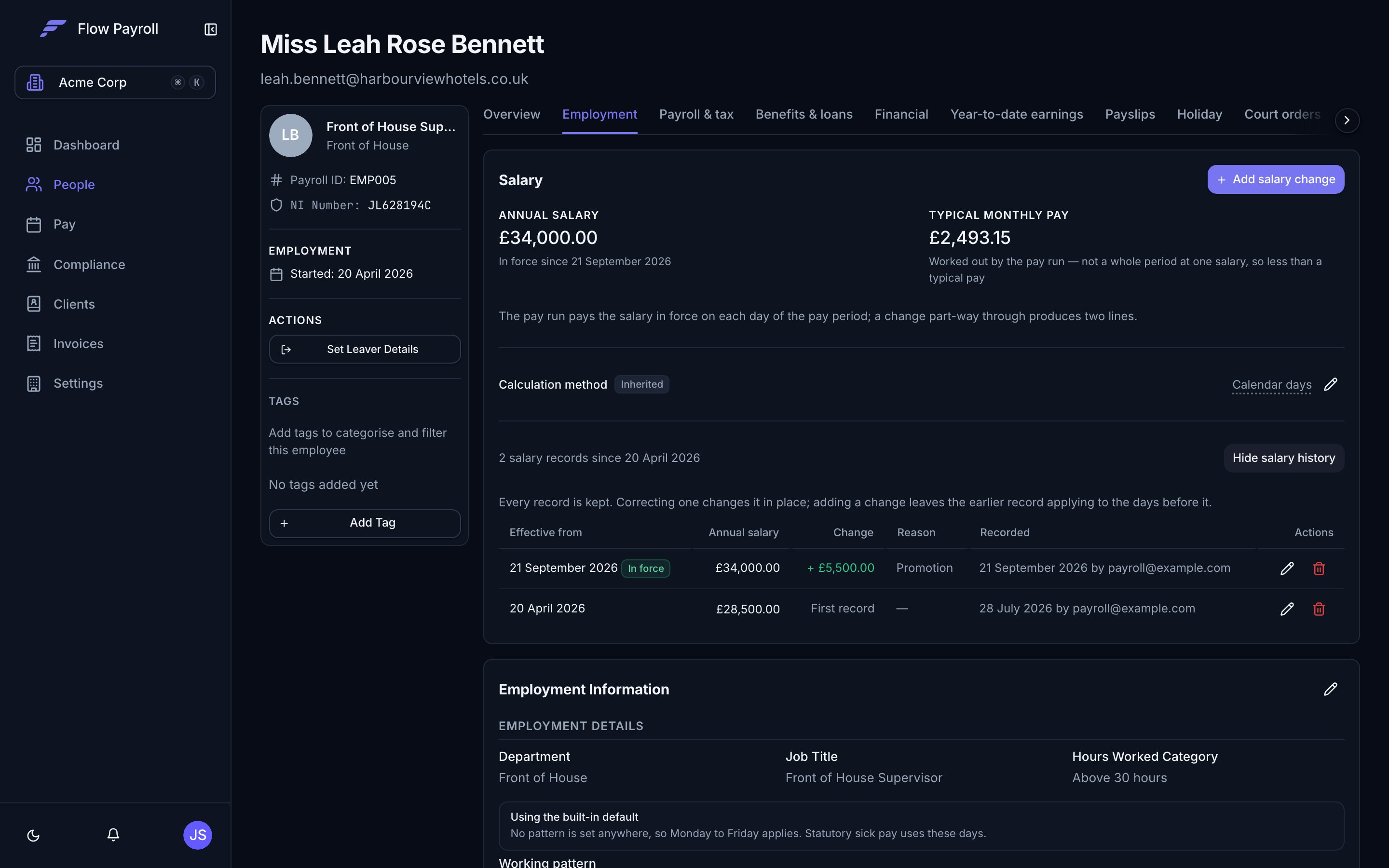 Everyone has at least one version. Employees whose salary was recorded before dated salaries existed show a single version effective from their start date, so there is nothing to tidy up.
## Add a change, or correct a record
These look similar and mean different things. Pick the one that matches what happened.
A new salary from a date. The previous figure stays in the history and still applies to the periods before that date. This is a rise, a promotion, or a reduction in hours.
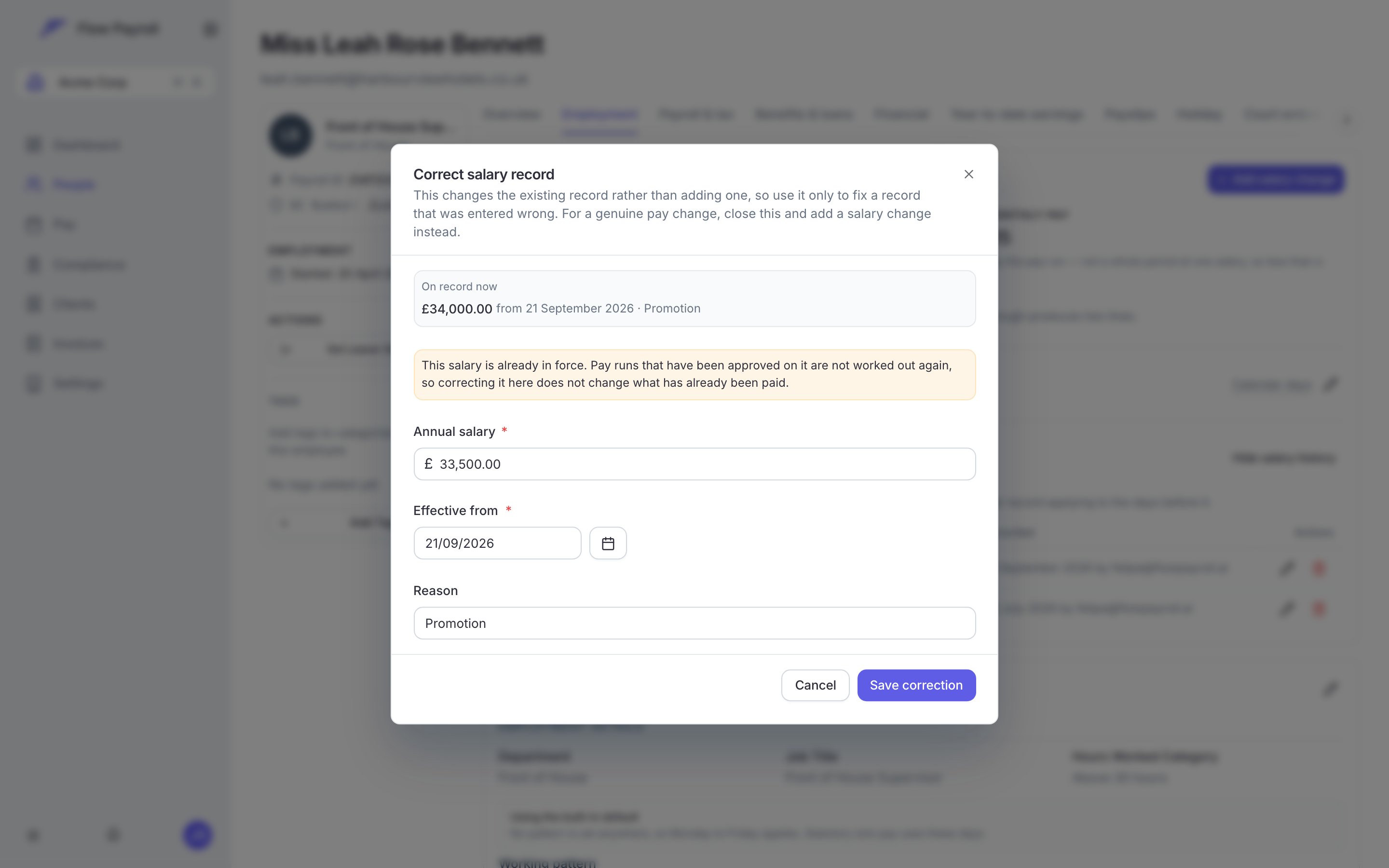
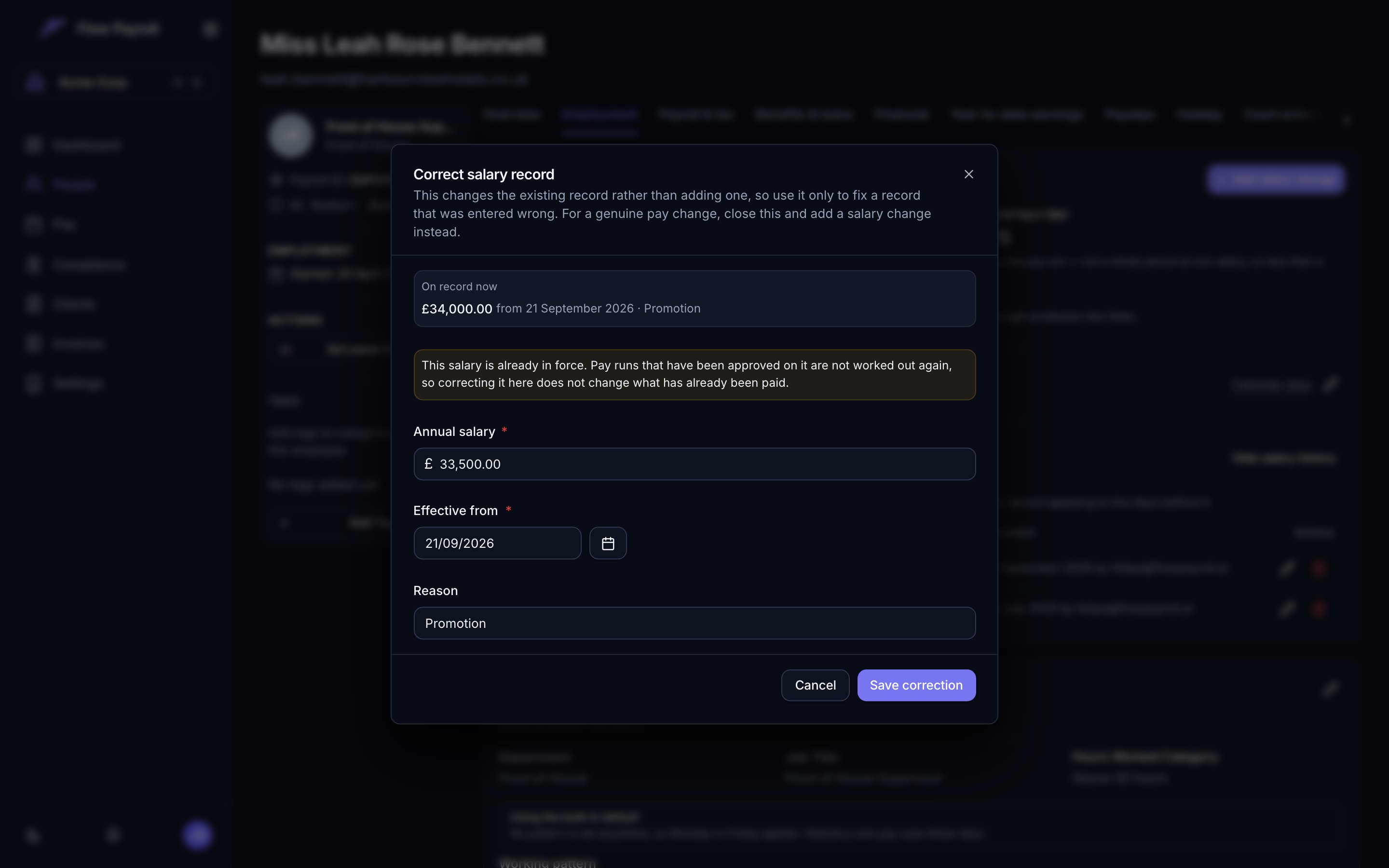
A figure that was recorded wrongly. Editing a version changes what the period it covers is worth, so use it only when the original entry was a mistake.
**People** → the employee → **Employment** → **Salary**.
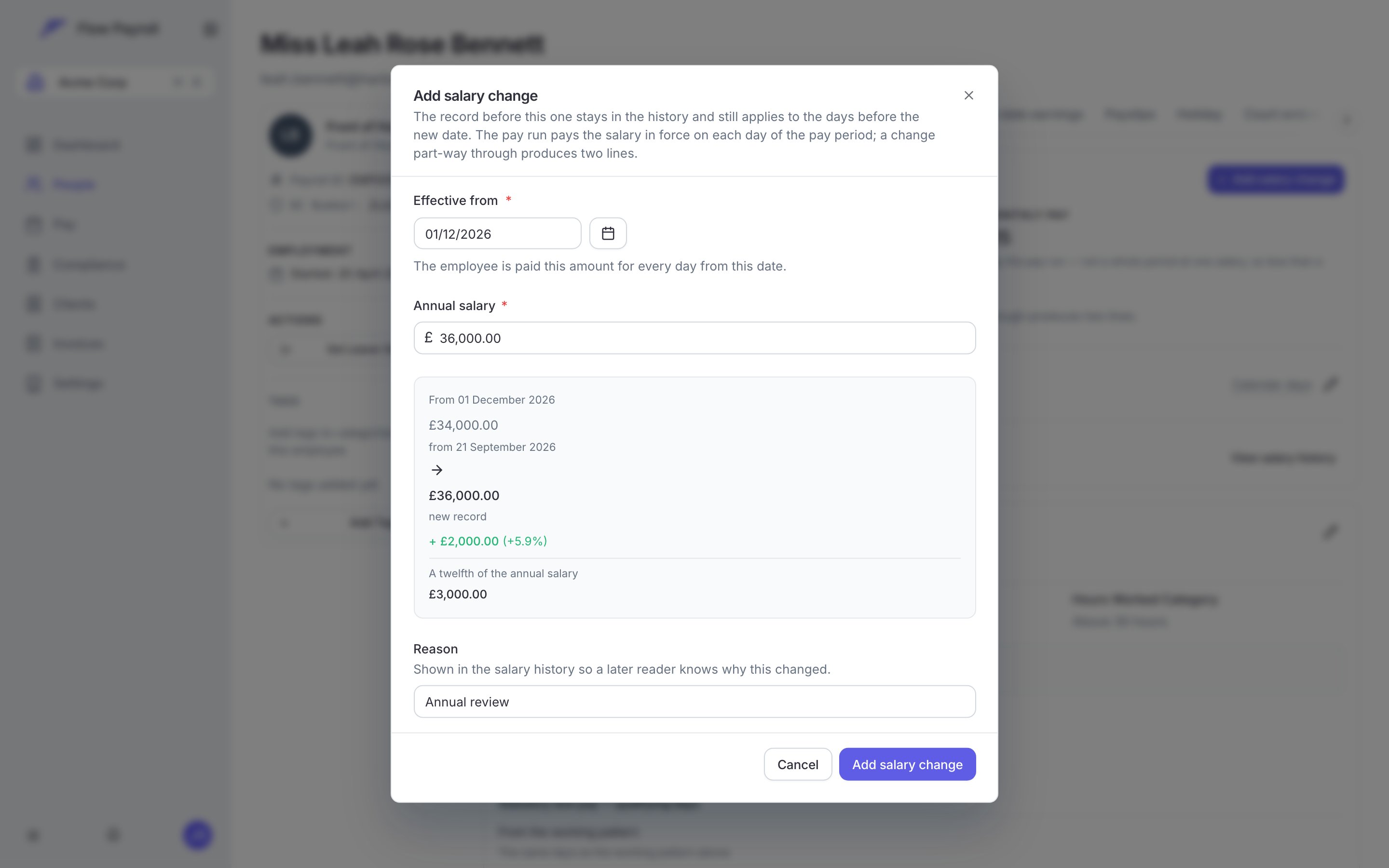
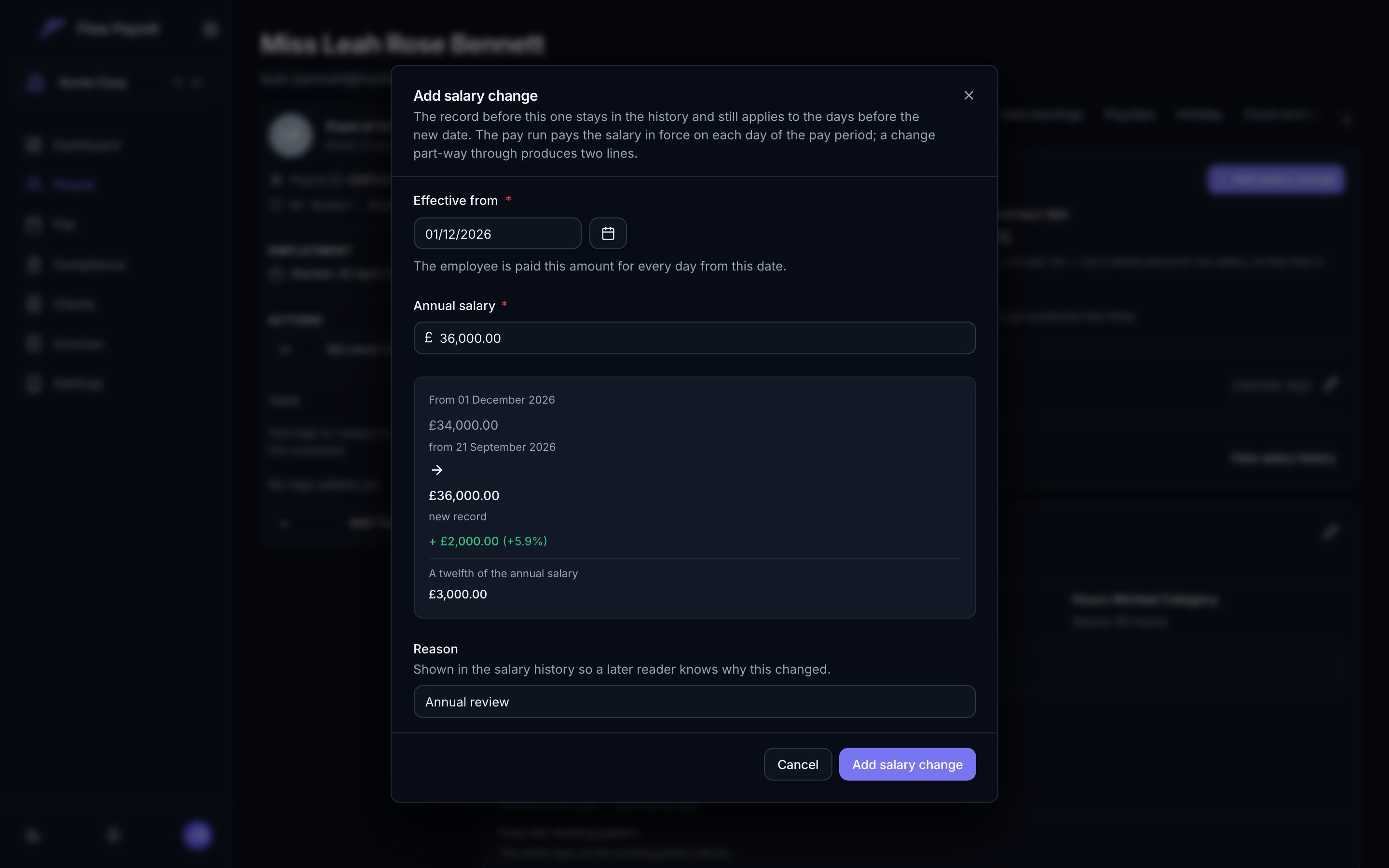
Click **Add salary change**, enter the annual salary and the date it takes effect, and add a reason if it helps whoever reads the record later.
Edit a row to change its amount or reason. To move a version to a different date, delete it and add the new one — a date is what identifies a version, so correcting one in place keeps the date it already has.
Any open pay run the employee is on is recalculated, so the change reaches the current period as well as future ones.
Everyone has at least one version. Employees whose salary was recorded before dated salaries existed show a single version effective from their start date, so there is nothing to tidy up.
## Add a change, or correct a record
These look similar and mean different things. Pick the one that matches what happened.
A new salary from a date. The previous figure stays in the history and still applies to the periods before that date. This is a rise, a promotion, or a reduction in hours.
A figure that was recorded wrongly. Editing a version changes what the period it covers is worth, so use it only when the original entry was a mistake.
**People** → the employee → **Employment** → **Salary**.
Click **Add salary change**, enter the annual salary and the date it takes effect, and add a reason if it helps whoever reads the record later.
Edit a row to change its amount or reason. To move a version to a different date, delete it and add the new one — a date is what identifies a version, so correcting one in place keeps the date it already has.
Any open pay run the employee is on is recalculated, so the change reaches the current period as well as future ones.
 Setting a salary to **0** is how you say somebody is not paid a salary from that date — a switch to timesheet-only pay, for example. The last remaining version cannot be deleted for that reason: deleting it would leave the record silent about what they earn, where 0 is a statement.
## How part periods are pro-rated
A full pay period is straightforward: the annual salary divided by the number of pay periods in the year. Twelve for a monthly payroll, 52 for weekly, and so on.
A part period is any period the employee was not employed and on the same salary throughout — a joiner, a leaver, or a period with a salary change in it. Those are paid per day, and you choose which days count.
| Method | Which days count | What the year divides by |
| - | - | - |
| **Calendar days** | Every day of the period, worked or not | 365, or 366 in a leap tax year |
| **Working days** | Only the days that employee works, from their working pattern | That employee's working days across the tax year |
Both sides use the same kind of day, which is what keeps the two consistent. Working days matter most for part-time staff: somebody on a three-day week has around 156 working days in the tax year, not 260, so their daily rate reflects the week they actually work rather than a five-day assumption.
The tax year is the one containing the start of the period being paid — the UK tax year runs 6 April to 5 April.
### Where to set the method
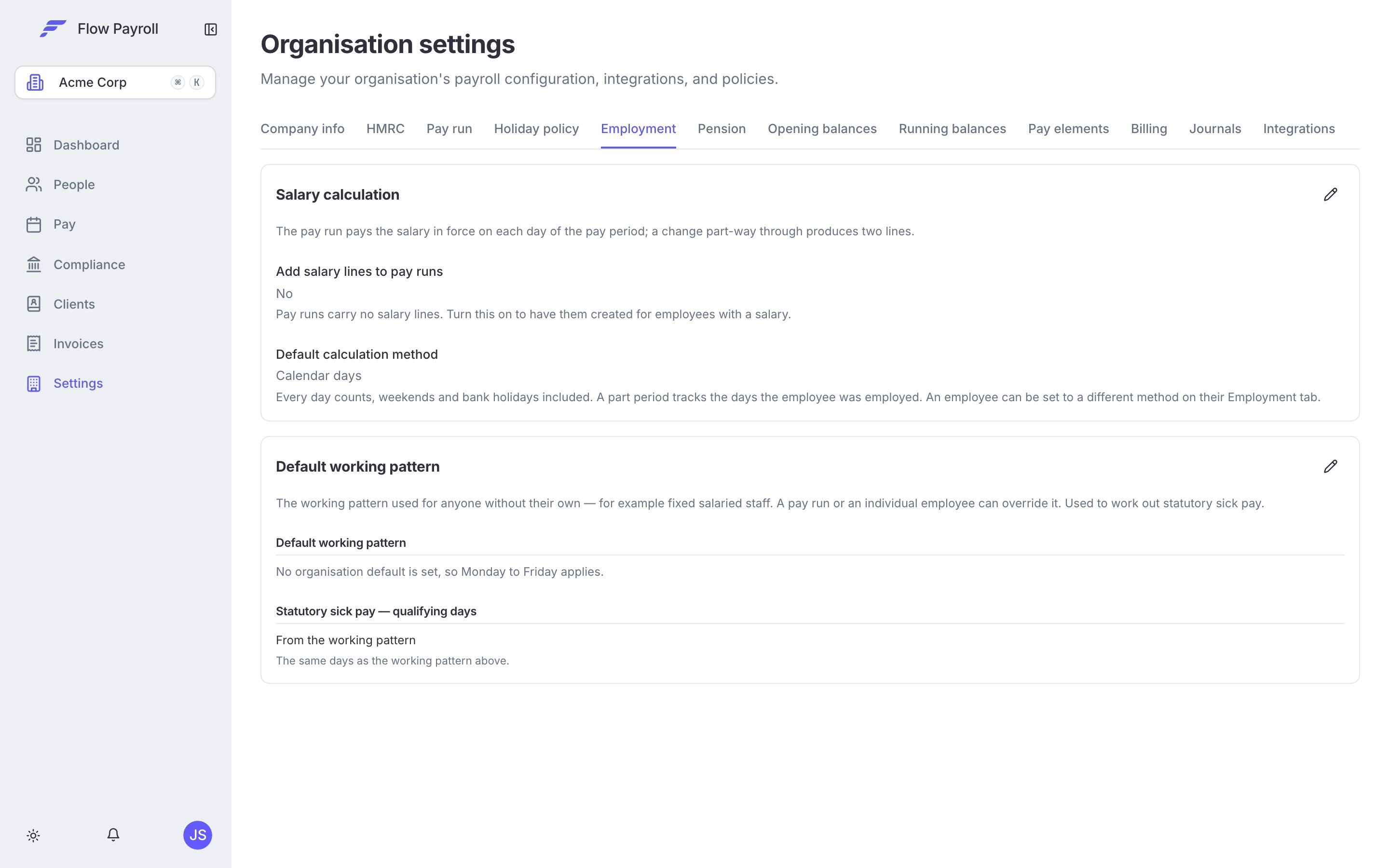
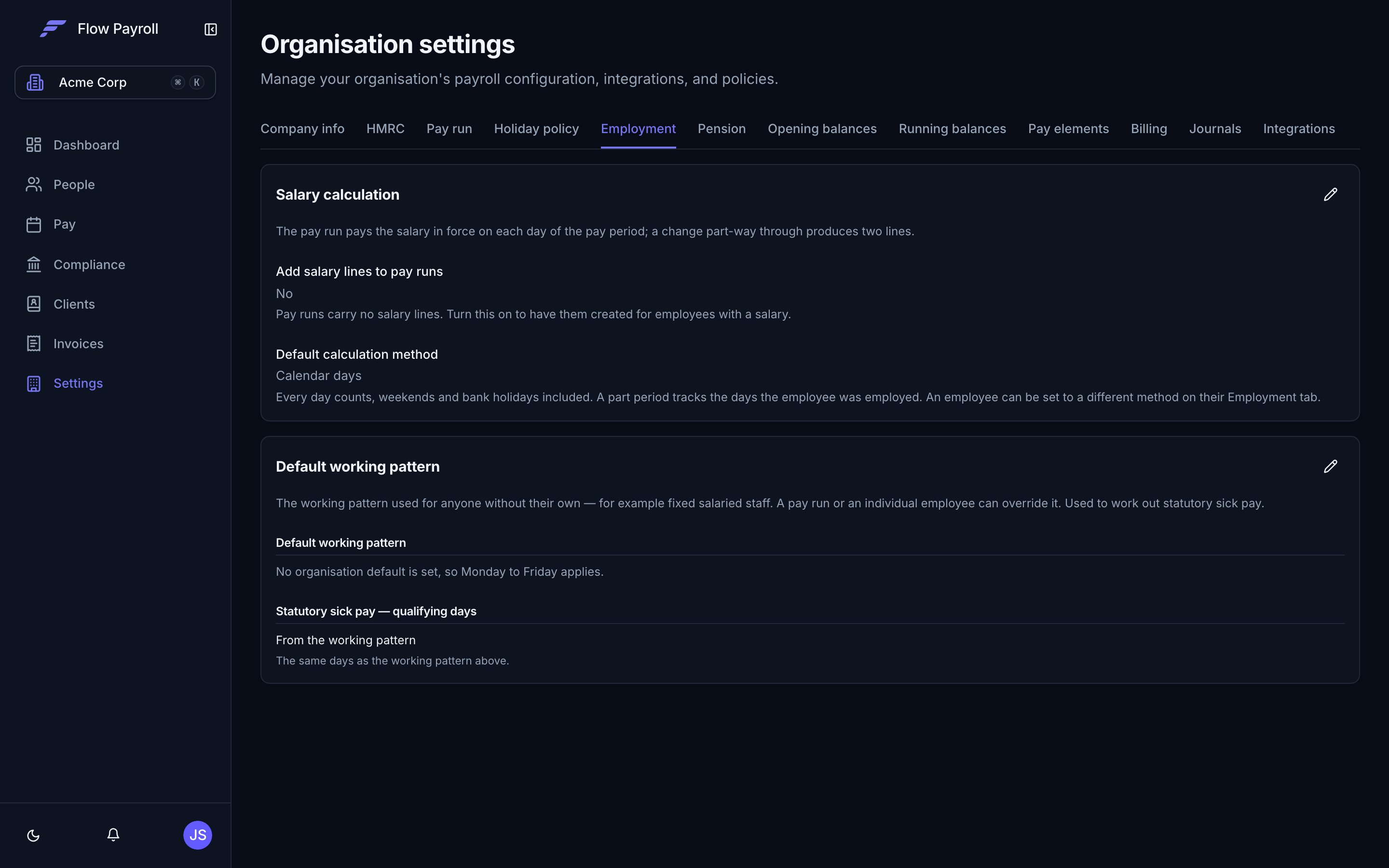
Set the organisation's method under **Settings** → **Employment** → **Salary calculation**. It applies to everybody unless an individual overrides it.
The same card carries **Add salary lines to pay runs**, which is what puts salary on a payslip at all. Turn it on and every employee with a salary on record gets a salary line; any open pay run is worked out again.
Setting a salary to **0** is how you say somebody is not paid a salary from that date — a switch to timesheet-only pay, for example. The last remaining version cannot be deleted for that reason: deleting it would leave the record silent about what they earn, where 0 is a statement.
## How part periods are pro-rated
A full pay period is straightforward: the annual salary divided by the number of pay periods in the year. Twelve for a monthly payroll, 52 for weekly, and so on.
A part period is any period the employee was not employed and on the same salary throughout — a joiner, a leaver, or a period with a salary change in it. Those are paid per day, and you choose which days count.
| Method | Which days count | What the year divides by |
| - | - | - |
| **Calendar days** | Every day of the period, worked or not | 365, or 366 in a leap tax year |
| **Working days** | Only the days that employee works, from their working pattern | That employee's working days across the tax year |
Both sides use the same kind of day, which is what keeps the two consistent. Working days matter most for part-time staff: somebody on a three-day week has around 156 working days in the tax year, not 260, so their daily rate reflects the week they actually work rather than a five-day assumption.
The tax year is the one containing the start of the period being paid — the UK tax year runs 6 April to 5 April.
### Where to set the method
Set the organisation's method under **Settings** → **Employment** → **Salary calculation**. It applies to everybody unless an individual overrides it.
The same card carries **Add salary lines to pay runs**, which is what puts salary on a payslip at all. Turn it on and every employee with a salary on record gets a salary line; any open pay run is worked out again.
 To override it for one person, use the **Calculation method** control on their **Salary** card. Leave it set to inherit and they follow the organisation.
Changing one employee's method recalculates any open pay run they are on straight away. Changing the organisation's method does the same for every employee who follows it: each open pay run is worked out again, so the change reaches the current period as well as future ones. On a large organisation this happens in the background over a short while rather than all at once. Locking a pay run waits for any payslip still being recalculated before it finalises, so a change that is already on its way is never half-applied — but leave a moment between a change and the lock, and check the payslip lines before you lock, because nothing is written into a period once it is locked.
## What the pay run does
Salary appears as a line on the payslip, alongside everything else you pay.
* **A full period** is one line for the period's share of the annual salary.
* **A joiner or a leaver** is one line for the days they were employed in the period, at the daily rate.
* **A payment after leaving**, such as a bonus that was missed, gets no salary line. The period is after their leaving date, so there is no salary to pay; add the payment as its own line.
* **A salary change part-way through** is **two** lines: the old salary up to the day before the change, and the new salary from the day it takes effect. Each line names its dates and the days it covers, so the payslip explains itself.
* **Days before an employee's first salary version** are not paid. If a joiner's salary starts later than their start date, the gap is deliberate.
* **Correcting a start date moves the first salary version with it.** The starting salary is recorded from the start date, so when you fix that date the salary follows and the joiner is paid from the corrected day. If the corrected date would land on or after the next salary version, the change is refused until you tidy the history.
Salary lines are worked out, not typed: they cannot be edited or removed on the payslip, the same as statutory payments. That is what lets a later salary change or a corrected record always reach the pay run. To pay somebody more or less than their salary in a period, add a separate line for the difference.
When the employee is also paid statutory pay (sick, maternity or other family leave), the salary for those days is taken back with a separate line, and can be topped up. See [Salary during statutory leave](/guides/people/salary-during-statutory-leave).
## Working through the API
| What | Endpoint |
| - | - |
| Read an employee's salary history | `GET /employees/{employeeId}/salary` |
| Record a salary from a date | `PUT /employees/{employeeId}/salary` |
| Remove one version | `DELETE /employees/{employeeId}/salary/{effectiveFrom}` |
| Organisation calculation method | `GET` / `PUT` / `DELETE /organisation` on the Salary API |
| Employee override | `GET` / `PUT` / `DELETE /employees/{employeeId}` on the Salary API |
| See what a period would produce | `POST /employees/{employeeId}/calculate` on the Salary API |
Sending `salary` on `PUT` or `PATCH /employees/{employeeId}` is deprecated and stops being accepted on **20 December 2026** — use `PUT /employees/{employeeId}/salary` so the change carries a date. See the [Salary API overview](/api-reference/salary/overview) and [Deprecations](/api-reference/deprecations).
## Related
The days an employee works, which is where working-day pro-rata comes from.
Where salary lines appear, and how to change them before you lock.
What happens to the salary on days paid by statutory sick or family-leave pay.
This documentation is built and hosted on [Mintlify](https://mintlify.com), a developer documentation platform.
To override it for one person, use the **Calculation method** control on their **Salary** card. Leave it set to inherit and they follow the organisation.
Changing one employee's method recalculates any open pay run they are on straight away. Changing the organisation's method does the same for every employee who follows it: each open pay run is worked out again, so the change reaches the current period as well as future ones. On a large organisation this happens in the background over a short while rather than all at once. Locking a pay run waits for any payslip still being recalculated before it finalises, so a change that is already on its way is never half-applied — but leave a moment between a change and the lock, and check the payslip lines before you lock, because nothing is written into a period once it is locked.
## What the pay run does
Salary appears as a line on the payslip, alongside everything else you pay.
* **A full period** is one line for the period's share of the annual salary.
* **A joiner or a leaver** is one line for the days they were employed in the period, at the daily rate.
* **A payment after leaving**, such as a bonus that was missed, gets no salary line. The period is after their leaving date, so there is no salary to pay; add the payment as its own line.
* **A salary change part-way through** is **two** lines: the old salary up to the day before the change, and the new salary from the day it takes effect. Each line names its dates and the days it covers, so the payslip explains itself.
* **Days before an employee's first salary version** are not paid. If a joiner's salary starts later than their start date, the gap is deliberate.
* **Correcting a start date moves the first salary version with it.** The starting salary is recorded from the start date, so when you fix that date the salary follows and the joiner is paid from the corrected day. If the corrected date would land on or after the next salary version, the change is refused until you tidy the history.
Salary lines are worked out, not typed: they cannot be edited or removed on the payslip, the same as statutory payments. That is what lets a later salary change or a corrected record always reach the pay run. To pay somebody more or less than their salary in a period, add a separate line for the difference.
When the employee is also paid statutory pay (sick, maternity or other family leave), the salary for those days is taken back with a separate line, and can be topped up. See [Salary during statutory leave](/guides/people/salary-during-statutory-leave).
## Working through the API
| What | Endpoint |
| - | - |
| Read an employee's salary history | `GET /employees/{employeeId}/salary` |
| Record a salary from a date | `PUT /employees/{employeeId}/salary` |
| Remove one version | `DELETE /employees/{employeeId}/salary/{effectiveFrom}` |
| Organisation calculation method | `GET` / `PUT` / `DELETE /organisation` on the Salary API |
| Employee override | `GET` / `PUT` / `DELETE /employees/{employeeId}` on the Salary API |
| See what a period would produce | `POST /employees/{employeeId}/calculate` on the Salary API |
Sending `salary` on `PUT` or `PATCH /employees/{employeeId}` is deprecated and stops being accepted on **20 December 2026** — use `PUT /employees/{employeeId}/salary` so the change carries a date. See the [Salary API overview](/api-reference/salary/overview) and [Deprecations](/api-reference/deprecations).
## Related
The days an employee works, which is where working-day pro-rata comes from.
Where salary lines appear, and how to change them before you lock.
What happens to the salary on days paid by statutory sick or family-leave pay.
This documentation is built and hosted on [Mintlify](https://mintlify.com), a developer documentation platform.